2025 Update
The City of Goleta is raising funds to implement the Ellwood Trails and Habitat Restoration Project.
For more information, see the City of Goleta article
2020 Update
In October 2019, the California Coastal Commission (CCC) approved the City’s Ellwood Trails and Habitat Restoration Project with a Notice of Intent to Issue Permit. Approval under the Coastal Act was conditioned on nine special conditions (see the Notice of Intent to Issue Permit). A number of the requirements have already been completed, including environmental review and permit acquisition from other regulatory agencies; the remaining requirements will be met before, during, and post-project activities.
Early in 2020, the project was transferred from the Advance Planning staff to the Public Works Department and will be administered by the City’s Parks & Open Space Manager.
Project History
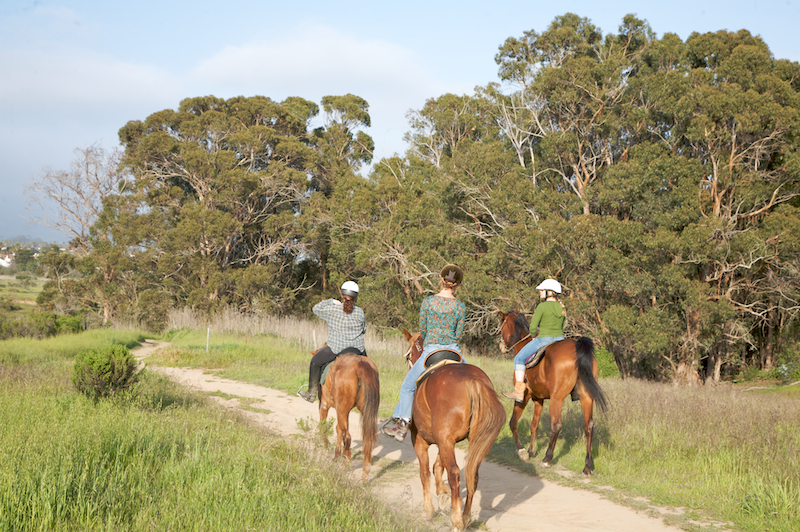 Ellwood Mesa is part of the Ellwood Devereux Open Space, a 652-acre multi-agency regional open space that includes open space and reserves on UCSB's North and West Campus, lands within the University System's Coal Oil Point Reserve, the Santa Barbara County Land Trust Coronado Butterfly Preserve, and the City of Goleta's Ellwood Mesa and Sperling Open Space. An integrated trail system of over 10 miles links all of these open space areas and the County unincorporated community of Isla Vista to University lands and to areas such as Ellwood within the City of Goleta. The linked trail system, the area's beauty and natural resources, and proximity to the surrounding community result in heavy use of Ellwood Mesa by residents of the City of Goleta, Isla Vista, and UCSB. However, as the largest publicly owned coastal open space on the South Coast of Santa Barbara County, the Ellwood Mesa Trail system serves residents from throughout the South Coast and County, as well as visitors to our community. The Monarch Butterfly Preserves draw visitors and school children from throughout the County and our region.
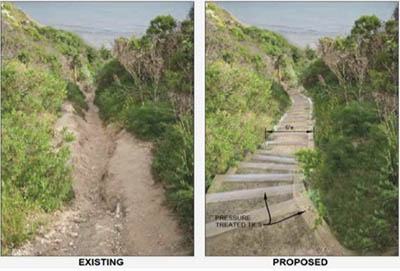 The Ellwood Mesa trail system is in its organic state. It is a series of unimproved dirt trails and old roads that traverse the environmentally sensitive habitats of the Mesa and provide beach access via eroded canyons and gaps in the bluff face. As a result of their evolution as an informal trail system over the last 30 years, trails on the Ellwood Mesa cause erosion into adjacent habitats and impede trail use by some segment so of the community due to ponding after rainfall, which causes trail users to bypass these flooded areas, trampling adjacent habitats during the wet season. In addition, trails cross eroded areas, gullies and Devereux Creek presenting obstacles to various user groups. The beach access trails descend steep coastal bluffs, have never been developed as formal trails and are subject to or contributing to bluff face erosion. In addition, portions of the trail system, particularly along the bluff face, have been subject to wide spread invasion by non-native vegetation (e.g., ice plant, fennel) which displace sensitive native species and which can also increase bluff face erosion and instability.
Therefore, although the existing trail system provides public access to and across the Ellwood Mesa, it is contributing to the gradual deterioration of adjacent habitats, and segments can become unusable during and after rainfall events. Further, the steep coastal access trails lack drainage and erosional control features, causing damage to the bluff face and threatening the trails with damage and erosion. This erosion and areas of uncontrolled access also foster large swaths of non native species and can present threats to public safety. This project will remedy these existing problems.
Scope of Work:
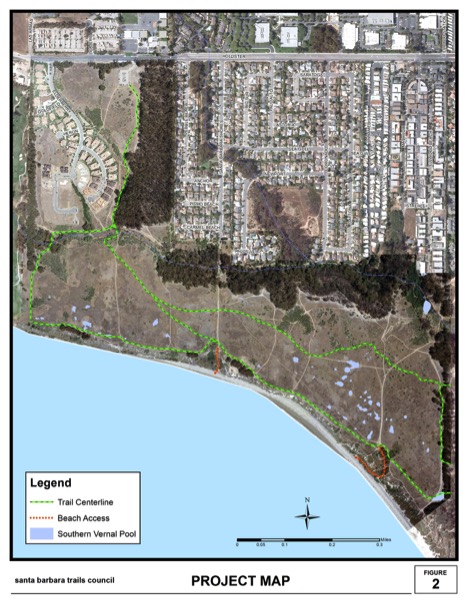 The Santa Barbara County Trails Council (Trails Council) in coordination with the City of Goleta is pursuing enhancement of 2.2 miles of the California Coastal Trail and De Anza National Historic Trail and improvements to two associated coastal access points on the Ellwood Mesa (see red lines on Project Map). The goal of the Ellwood Mesa Coastal Trail Enhancement and Habitat Restoration Project is to improve public access to and along the coast on the Ellwood Mesa in an environmentally sustainable manner. The project includes improved creek and drainage crossings, substantial habitat restoration and erosion control to minimize habitat impacts, including those to environmentally sensitive native grasslands, vernal pools and coastal bluff scrub. The erosion control measures are designed to minimize sediment runoff into Devereux Creeks, vernal pools, and to reduce bluff erosion. Trails would retain natural surfaces consistent with the City’s General Plan.
To date, the Trails Council’s team of planners, engineers and environmental specialists have completed trail and coastal access design, habitat restoration and erosion control plans and permit applications. A wetland delineation study and Mitigated Negative Declaration (MND) have also been completed. The planning phase was funded by grants provided by the State Coastal Conservancy ($100,000), Goleta Valley Land Trust ($50,000), Coastal Resource Environmental Fund ($35,000) and the UCSB Coastal Fund ($9,920.00).
Why Is This Important:
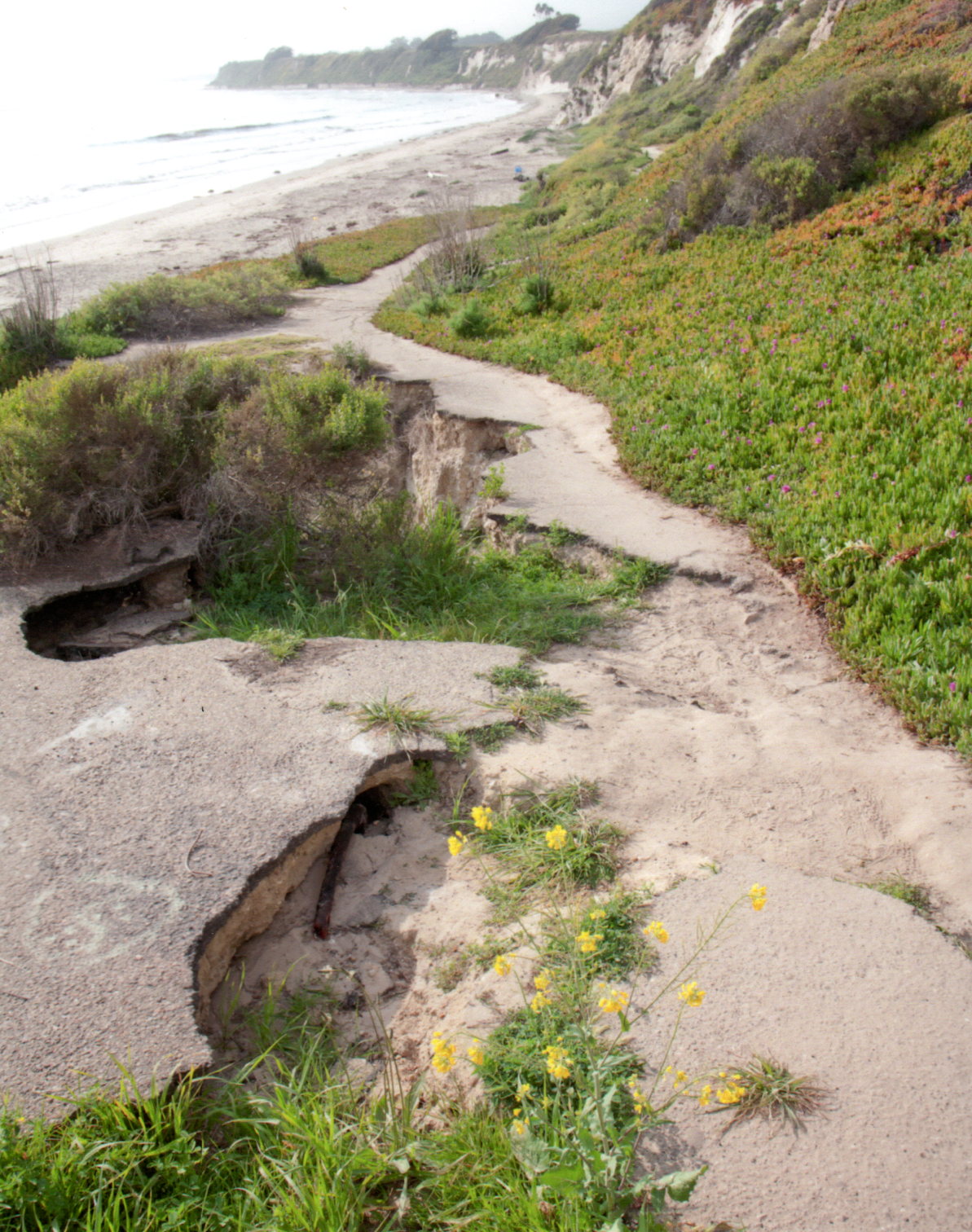 Of particular importance in this scenic open space are 2.2 miles of the California Coastal and De Anza National Historic Trails which traverse the Ellwood Mesa, along with two important public beach access points. The Ellwood Mesa is a key local segment of the statewide California Coastal Trail, planned to provide a continuous trail as close to the ocean as possible, with vertical access connections at appropriate intervals and sufficient transportation access to encourage public use. Running parallel to the California Coastal Trail is the federally recognized segment of the historic Juan Bautista de Anza Trail. The two existing informal beach access trails allow the public to gain access to the wide sandy beaches below the Ellwood Mesa. As the largest publicly owned coastal open space on the South Coast of Santa Barbara County, the Ellwood Mesa Trail system serves residents from throughout the South Coast and County, as well as visitors to our community. As a multi-use trail the Ellwood Mesa Trails are open to the safe shared use by everyone.
The Outcome:
- Provide safer public access from the bluff top to the beach at two locations
- Improve erosion control and sustainability of 2.2 miles of trail
- Install boardwalks to provide dry creek and drainage crossings
- Remove invasive non-native plants and restore native habitats
- Protect environmentally sensitive native grasslands, vernal pools and coastal bluff scrub
- Increase recreational opportunities for the whole community
- Enhance free outdoor gym for health, fitness and overall wellness
Phase One Coastal Beach Access Budget:
The trail restoration project is divided into phases that will require approximately $1.4 million to complete over several years with 1/3 of the cost for trails and 2/3s of the cost for habitat restoration:
- Beach Access Trail (Point E):.............$70,000
- Beach Access Stairs (Point F):............$60,000
- Adjacent Habitat Restoration:..........$120,000
GRAND TOTAL..........................................$250,000